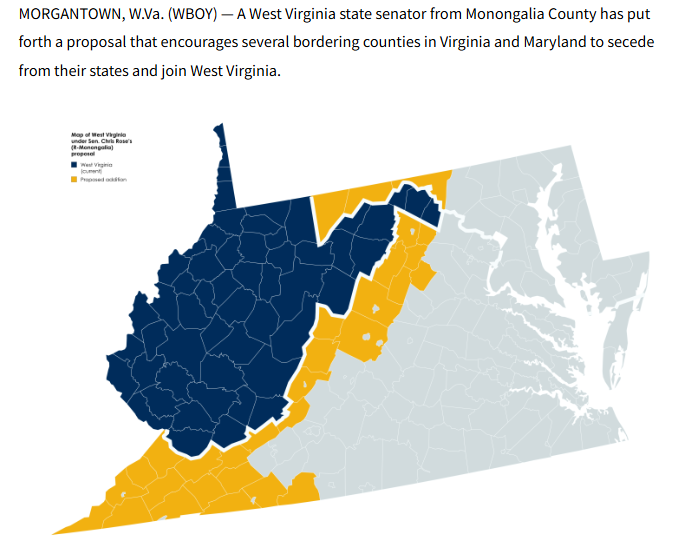
Idaho isn’t the only U.S. State where there has been a Proposal to expand the Borders of the state by adding Right Wing Counties of bordering (Deep) Blue States thereto.
In 2021, then Governor of West Virginia @jimjusticewv held a Press Conference to Address a Proposal by select Legislators in Western Maryland to the Counties they represent (Allegany, Garrett, and Washington) become part of West Virginia.
Fast forward to November 2025: West Virginia State Senator @ChrisRoseWV lodges a Resolution in the West Virginia Legislature for the Aforementioned three (3) Western Maryland Counties to join twenty-seven (27) Western Virgin Counties (Alleghany, Augusta, Bath, Bland, Buchanan, Carroll, Clarke, Craig, Dickenson, Frederick, Giles, Grayson, Highland, Lee, Page, Patrick, Rappahannock, Rockingham, Russell, Scott, Shenandoah, Smyth, Tazewell, Warren, Washington, Wise and Wythe) in seceding from their respective states to become part of West Virginia.
While @ChrisRoseWV cited shared “geographic, economic, cultural and historical” commonalities between the Aforementioned thirty (30) Counties and West Virginia, the secessionist sentiment appears to have been revived due to the election of Progressive Democrats @jonesjay and @SpanbergerForVA to the Attorney Generalship and Governorship of Virginia, respectively.
This is most evident by commentary offered by @MorriseyWV, the current Governor of West Virginia, regarding the results of the Virginia Attorney Generalship and Gubernatorial Elections, stating “It’s about to get awful [B]lue in the [C]ommonwealth of Virginia. Don’t wait for the high [T]axes [and] heavy [R]egulations to come, now is your chance toe scape to the wild and wonderful West Virginia.”
Political Commentator @Dgingsz published Commentary over on YouTube about the “state-splitting” Proposal. I would like to address some of the pointes raised in his Commentary, as I think it’s beneficial to delve a bit further into some of the questions he posed.
While @dgsingsz does not pose this as a question in his Commentary, I would like to take a moment to discuss how “state – splitting” can occur from a constitutional stand-pointe.
To be clear, we define “state-splitting” as: the Secession of a sub-division (i.e., County, or a Municipality of some forme, whether it be a Towne, Village, Parish or City) from its current U.S. State and Admission to one that it would be more Socially, Culturally, Religiously, Politically and/or Economically Aligned with.
The Constitution does not directly enumerate a process for parts of a current U.S. state to become part of another U.S. state. However, the language of Article IV, Section 3 Clause 1 of the Constitution provides a framework within which “state-splitting” can constitutionally occur.
“…no new State shall be formed or erected within the Jurisdiction of any other State; nor any State be formed by the Junction of two or more State, or Parts of States, without the Consent of the Legislatures of the States concerned as well as of the Congress.”
Based on this language, we can infer that the “Spirit” of Article IV, Section 3 Clause 1 is such that any and all Adjustments to the Territorial Integrity of any U.S. State requires not only the Consent of both Houses of Congress, but, most crucially, the Consent of all U.S. States whose Territorial Integrity would be affected by such Adjustments.
Congressional oversight in this matter is, of course, constitutionally mandated. However, Congressional oversight is necessary from a practical perspective because the Power to Enact Legislation for the Preservation, Protection and Defence of the Homeland (that is, the Union) belongs solely to Congress.
A perfect example of this is Immigration Policy. Though this is a Novel Legal Concept, I posit that, in accordance with the 10th Amendment, each U.S. State’s Legislature retains the Authority to determine whether or not individuals who have migrated to the United States can and should be permitted to establish residency in and of the U.S. State in question – and if so, what should and must be required to establish said Residency.
Notwithstanding the Novel Nature of the Aforementioned Legal Concept, what is absolutely NOT in dispute is the fact that the Authority to legally define who is permitted – and what is Required – to Immigrate to the United States is vested in Congress.
The same logic can be applied to Congressional oversight in the Admission of New U.S. States and the Adjustment of the Territorial Integrity of extant U.S. States: each U.S. State’s Authority to Protect, Preserve and Defend its Territorial Integrity ends where that of another U.S. State’s begins. That intersection is where Congress, in theory and in practice, sits, ensuring that all U.S. States have the over – arching protections extended to the Homeland in general, while protecting each U.S. State’s Territorial Integrity from encroachment by other U.S. States.
As @Dgingsz rightly asserts in his Commentary, one U.S. State would not voluntarily “give up” its land to another U.S. State – unless, of course, their is something to be gained by the U.S. State whose Territory would be reduced.
Given the nature of contemporary state level politics, such decisions would be driven by Fiscal Policy, Economic Policy – or, more likely, some combination of both.
An example of how Fiscal Policy could enable state – splitting is if the sub-division of a U.S. State that wishes to secede is a Net Recipient of Dollars from the state capital.
Annapolis may conclude that it is fiscally beneficial to permit Allegany, Garrett and/or Washington Counties to become part of West Virginia if one, some or all of those three counties in Western Maryland have consistently been a Net Receipient of Dollars therefrom. Annapolis could justify the decision by concluding that the Dollars can and should be diverted to “historically marginalised communities” in those parts of the state where they are dominant. While Annapolis’ rationale would be suspect, it would still yield the effect that state-splitting seeks to achieve: Social, Cultural, Economic Religious and/or Political Alignment.
An example of how Economic Policy could inhibit state – splitting is if the sub-division of a U.S. State that wishes to secede engages in some Activity in the Market that would, if it seceded from the U.S. State in question, have negative downe-stream effects on the Economy of the U.S. State in question.
Maryland has a total of 12,550 Farms. of that figure, 1,293 Farms – or 10% of all Farms in the state, comprising about 6% of the state’s Farmland – are located in Allegany, Garrett and Washington Counties. The most commonly grown crop across the Farms in the Aforementioned Counties is Yellow Corn. Annapolis could conclude that permitting one, some or all of these Counties to secede would currently or could, at some pointe in the future, be dis-advantageous to the state’s Economy.
For one thing, given that High Fructose Corn Syrup is contained in a myriad of Foods, Annapolis could refuse to permit these Counties from seceding on the grounds that the state would be opening itself up to a degree of un-necessary economic instability, given that the common “cash crop” of the Farms in these Counties is Yellow Corn.
Annapolis could equally simply conclude that – as Farmland is some of the most valuable land in the country, with varying uses constantly coming into existence as the Economy transforms – permitting these three Counties to secede with 10% of the state’s Farmland is simply detrimental to the long-term Economic interest of the state.
A key pointe raised by @Dgingsz in his Commentary is the fact that the “Greater West Virginia” Movement will cease to remain relevant unless and until it becomes a (highly) strategic initiative with clear leadership. This is indeed the only way to create the level of visibility needed to ensure that the conversation continues consistently, especially when there are no attention – grabbing headlines to fill airwaves, commentary, and articles. The push for a “Greater West Virginia” needs to be carefully and strategically nurtured until it is at least on par with the Greater Idaho Movement, CALEXIT, and TEXIT.
Despite my initial disdain for the notion of state – splitting when initially presented to me by @state_secession, I more clearly see the benefit of employing such a stratagem as a tool to effect increased Social, Cultural, Religious, Political and/or Economic Alignment. While I am still of the opinion that state – splitting makes the most sense where the states directly border each other (as with Idaho and Oregon and West Virginia, Maryland and Virginia), it should and must be leveraged to the greatest extent to which it is possible, especially where Peaceful National Divorce will the likely outcome of its use.
If the results of the November 2025 Elections are any indication, one is of the opinion that the Overton Window will shift far enough that a definition of “state – splitting” that is more palatable to common sensitivities will become necessary.
Source Material:
- Gov. Justice, legislative leaders address proposal for 3 western Maryland counties to join West Virginia ‘a chance to live in paradise’
- Mon County senator wants some VA, MC counties to join West Virginia
- West Virginia wants to *ADD* counties from Virginia & Maryland
- 3 counties looking to leave Maryland, requesting to join West Virginia
- State senator invites some Maryland and Virginia counties to join West Virginia
- Legislators want three counties to secede Maryland for West Virginia
- An Annotation of Article IV, Section 3 of the Constitution of the Federal Republic of the United States of America
- Top Maryland Agriculture Facts From the 2024 Census of Agriculture
- Counties with the most farmland in Maryland
Leave a Reply