In September, I became engaged in a rather spirited debate on X with @state_secession regarding the Topic of Peaceful National Divorce.
Throughout the course of that Debate, I crafted, in addition to several responses to replies offered by the Content Creator, two Articles of relevance to the topic.
The First, published on 14 September 2025 entitled “National Divorce, now!” is a Reaction piece based on Commentary published by @timotheeology on YouTube entitled “We Cannot Share a Country with these People: The Peaceful Solution.”
The Second, published on 22 September 2025 entitled “Which U.S. States are Red States?” is a General Commentary which details my methodology for how I define Red State.
As part of our Spirited Debate, @state_secession referred me to an Article on their Website redstatesecession.org, entitled “Where North America would split in a Peaceful National Divorce.”
I’ve finally gotten around to reading the Article and thinking about the information presented therein.
Thus, I am ready to provide some Commentary.
NOTE: many perceive conversations such as these to be insignificant to the Modus Operandi of the Right Wing Movement. I would contend that the fact that many on the Right would see such conversations as effectively futile is the problem. A Movement cannot and will not achieve practical success of any sort or kind without an Intelligencia – a small group of individuals whose duty it is to design, and where necessary, alter the Philosophical Basis of the Movement in question. It is therefore not only absolutely necessary for but incumbent upon the leadership of the the Right Wing Movement to encourage those whose strong suit is writing and thinking about the obstacles facing the Right Wing Movement to do so, with vigor and force. One such issue that should be vigorously discussed and debated in Right Wing Intellectual Circles is (Peaceful) National Divorce. Those thinkers in the movement who are interested in this topic should find it compelling to engage on this matter, as doing so will likely serve, at the very least, as the foundation for parallel societies across the country, and, at the very most, the resurrection and resumption of the Confederacy, updated for the contemporary landscape.
The White Anglo-Saxon Protestant Meta-Narrative
I find it rather interesting that @state_secession frames Peaceful National Divorce within a North American, as opposed to just an American, dynamic. While American and Canadian Constitutional Republicanism appears to be vastly different, they share much in common.
One of the key differences is that the Dominion of Canada – which, by the way, IS a de jure Confederacy – has a Hereditary Monarch as her Head of State, which she shares with the other fourteen Commonwealth Realmes. While some would argue that this makes the Dominion of Canada a Constitutional Monarchy and not a Constitutional Republic, I would posit that she is, like the other fourteen Commonwealth Realms, a Crowned (or Monarchical) Republic.
That is not to say that the Majesty of each of the Commonwealth Realmes has no effective power – nay, the Monarch of each of the Commonwealth Realmes has merely ceded their Prerogatives to others to wield on their behalf. As the Constitutions of each of the current Commonwealth Realmes is constructed, the Monarch – currently, Charles III – has authorities that he can (and some, such as myself, would argue, should) wield, but within a Constitutional Framework. This, when combined with the fact the Commonwealth Realmes are de facto Crowned Republics, is the reason why I define the Political Heritage of the Dominion of Canada in the same manner as that of the United States.
While I understand the reasoning behind @state_secession‘s assertion in the Article for the Canadian Provinces of Saskatchewan and Alberta and the Canadian Territories of Yukon, the Northwest Territories and Nunavut to become part of a New Red State Federation, I’d like to raise a few pointes that I think should be considered.
FIRST, while Canada and the United States share an English Heritage in common, the Politico-Religious outlook of the more Conservative segments of the Electorates in the Canadian Provinces and Territories in question isn’t as Conservative as the American counterparts.
While the Right Wing Political Parties throughout the Anglosphere are all rooted in English High Toryism, the expressions in each of the constituent countries that comprise the Anglosphere developed apart from each other.
This is especially true in and of the United States, as she is the only one of the other said constituent countries that gained independence from the Mother Country through War. By contrast, Canada, Australia and New Zealand gained Political Independence from the United Kingdome through a legislative process that, in some cases, didn’t crescendo until the early 20th Century.
The way we think of and “do” Politics here in the United States, in “Football Game Styled” Team Red and Team Blue didn’t become the status quo throughout the rest of the Anglosphere until during or after the tenures of Mrs. Thatcher in the United Kingdome and Mr. Reagan here in the United States.
Even though the other Constituent Countries of the Anglopshere have adopted this “Football Game Styled” Team Red and Team Blue Dynamic, it often doesn’t graft as accurately onto their Electorates as it does here in the United States, as it is a practice adopted by the Political Parties in Canada, the United Kingdome, Australia and New Zealand is still a relatively new and developing phenomena that must fully adjust to electoral norms specific to each Constituent Country before we can get a good sense of how directly comparable (or not) the Right Wing segments of those Electorates are to the Right Wing segments of the American Electorate.
One also has to consider that what constitutes Right Wing is shifting, with the base of Right Wing Parties becoming more Nationalist-facing – and in contrast, the base of Left Wing Parties become more Globalist-facing. While the Constituent Countries of the Anglosphere share a Common Anglo-Saxon Nationality, the expressions of that Nationality in each Constituent Country of the Anglosphere looks and fees more different. In Australia, it is perhaps more rugged. In the United Kingdome, it is more hierarchical. In the United States and Canada it is more Egalitarian, but in Canada it is both more Egalitarian and more Cosmopolitan/Metropolitan. In New Zealand, it is more tempered than it is in the other Constituent Countries of the Anglosphere, as they’ve made the most concessions to the descendants of pre-colonial populations.
Another key consideration is the political divide between men and women. While the trends track similarly in each of the Constituent Countries of the Anglosphere, there are still nuances specific to each such Country that often results in divergences that may make it difficult to implement Policies in the same manner across the Anglosphere.
Rectifying relations between men and women is crucial, such that without such a Rectification, the broader Anglo-Saxon “Super Nation” will struggle to remain a Going Concern as the 21st Century churns on. It is therefore crucial to Preserve, Protect and Defend the Political Nuances of each Constituent Country of the Anglosphere for the achievement of this very important end.
Another way you can examine the impact of the English Heritage on Canada, the United States, Australia and New Zealand is: Anglicanism.
In the United States, Anglicanism became Episcopalianism shortly after the American Colonies gained their Independence from the then Kingdome of Great Britain because it was not palatable to Americans to continue to maintain Allegiance to the British Monarch in their role as Defender of Anglicanism and Supreme Governor of the Church of England.
By contrast, the Anglicans in Canada, Australia and New Zealand didn’t have to break Allegiance with the British Monarch in this manner, as independence came legislatively. And even when that independence came, the Anglican Establishments in those countries became independent as “the Anglican Church of Canada,” “the Church of the [Anglican] Province of New Zealand” and “the Anglican Church of Australia.”
Episcopalianism in the United States and Anglicanism in the United Kingdome and Canada – and, quite possibly, Anglicanism in New Zealand – have all become Theologically Heterodox, while Anglicanism in Australia has remained relatively Theologically Orthodox.
To that end, a minor sect of Episcopalians in the United States and Anglicans in Canada, along with a few Anglican Congregations in Mexico, some Anglican Missions in Guatemala, and a Diocese in Cuba, have, in an effort to restore Orthodox Anglican Theology, formed an organisation known as The Anglican Church in North America (the ANCA). The ANCA has broken its link with the Church of England (the Mother Church of the Global Anglican Communion), becoming members of the more Theologically Orthodox Global Anglican Future Conference (GAFCON). Under the same rationale – the restoration of Orthodox Anglican Theology – groups of Clergy and Laity in Australia and New Zealand each have Provincial versions of GAFCON.
All of this to say: while the Dominion of Canada, and each Constituent Country of the Anglosphere, shares a common Politico-Religious Tradition, the nuance developed by each other time must be Restored. Such a Diversity will be crucial in ensuring that the Anglosphere remain a Going Concern in the coming Regionalised Worlde Order.
To that end, the Canadian Provinces of Saskatchewan and Alberta and the Canadian Territories of Yukon, the Northwest Territories and Nunavut could form a “New Canadian Confederacy,” with the “New Canadian Confederacy” entering into an European Union styled Pact with the proposed “New American Confederacy,” binding the two New Confederacies together, with the Modus Operandi of Preserving, Protecting and Defending the Common Interests of the Anglo-Saxon Peoples.
The Danish Territory of Greenland
As someone borne and reared in the U.S. Virgin Islands, I immediately made the connection between the sale of the then Danish Virgin Islands to the United States in the early 20th Century and the current political posturing by the White House regarding Greenland.
I ran an entire thread here on X whose main post simply reads:
“Greenland is this Century’s Danish Virgin Islands.”
In one of the follow-up posts in that “Thread,” I even joked about how I could have easily been speaking, reading and writing in Danish or German instead of English:

Needless to say, I took quite an interest in the Geopolitical Row that took place between Copenhagen and the White House during the Winter of 2024/25 in part because I was borne and reared in a place that was once Danish but no longer is for several reasons – key of which is the failure of a European Sovereign Capital to govern its colony practically (as opposed to idealistically).
I understand the White House’s posturing as it concerns Greenland: the 21st Century will be defined by Access to Natural Resources that gives Sovereign Capitals leverage in the ongoing Great Tech Race.
The Sovereign Capitals that succeed will not only be those that find ways to mitigate for declining Birth Rates, but those who manage to acquire and develop efficient means by and through which to develop the Natural Resources necessary to Power next Great Technological Turning. The 22nd Century will, like the late 15th Century through the mid to late 20th Century, be a Century of Empire: Sovereign Capitals that have the Natural Resources necessary to Power the next Great Technological Turning either have the skilled labour to cultivate said Resources and rapidly advances or become a vassal of a Sovereign Capital that the skilled labour to cultivate said Resources and rapidly advances.
In my Policy Proposal entitled “Greenland as an American Protectorate,” I propose, as the title indicates, that Greenland should become Independent of the Kingdome of Denmark but should, once independence is gained, become a Protectorate of the United States – such that the White House provides Military Protection in exchange for access to its Natural Resources and a prohibition Economic and Political Relations with Beijing.
If in the case the “New Canadian Confederacy” comes to fruition, it would be more geographically expedient for Greenland to either become part of that Confederacy or become a Protectorate thereof under the same conditions. This is workable in my theoretical scenario, as the New American and Canadian Confederacies would have a Comprehensive Pact that, in part, optimises commerce between the two Countries.
Pivot Back to American Domestic Geopolitics
One of the pointes that I assert is crucial in Peaceful National Divorce is for staunchly Red States to enact Policies that coerce “Blue People” to leave said states.
For a relatively short period of time, American Politics was shaped by Carpetbaggers (Northerners who opportunistically re-located to the South after the Second American Civil War to financially benefit from Reconstruction) and Scalawags (Southerners who supported Reconstruction in and through the South).
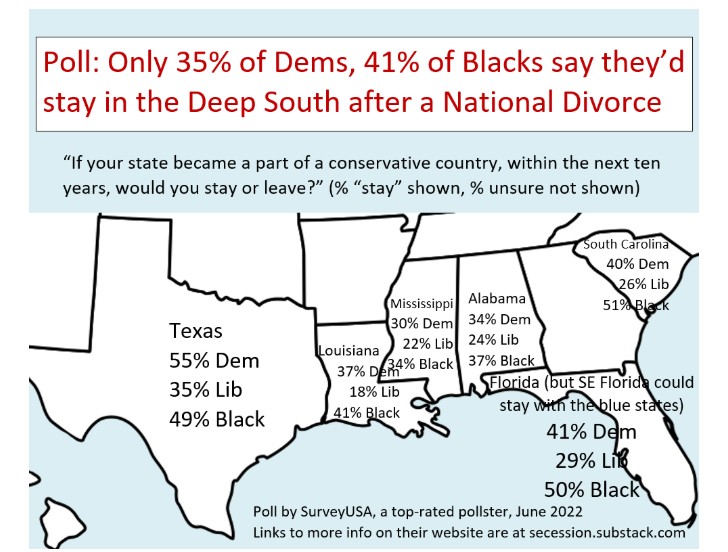
Those are the first two things that came to mind when I saw the below infographic embedded in @state_secession‘s article.

This infographic is precisely why I holde to the position that the Hard Right should relocate to those Deep Red States and take control of the Politico-Economic Apparatuses in those states and turn them, inextricably, exclusively in favour of the full scale Restoration of American Constitutional Republicanism.
In my Article entitled: “National Divorce, now!,” I discuss, in considerable detail, what I define as the six Sects of the Right Wing Movement:
- Libertarians
- Classical Liberals (think: Neoliberals/Establishment Democrats)
- Moderate Conservatives (think: Neoconservatives/Establishment Republicans)
- Right Wing Populists (think: Historical American Conservatism)
- Christian Nationalists (think: Christian Hard Right)
- Non-Christian Hard Right
As part of that Analysis, I explain why the Hard Right does not fit with the other four Sects of the Right Wing Movement, as currently constructed, or any of the other Sects of the American Electorate, for that matter:
The Average U.S. Citisen is either not Politically Affiliated, or if he is, he is a Neoliberal or Neoconservative. Even amongst the non-Politically Affiliated, their Political Orientation is some combination of Neoliberalism and Neoconservatism.
I then go on to explain why some of the states that @state_secession includes in the “New American Confederacy” should not be included:
Regarding Michigan, Illinois, New York, Colorado, New Mexico, Arizona, Minnesota, Ohio and Pennsylvania, I imagine that each of these states would form their own Polities (“the Independent Polities”), or some of them – namely, Colorado, New Mexico, Michigan, Illinois, and New York – becoming part of the the West Coast Polity.
Regarding the other states, I imagine a resurrection of the Confederacy, with all other states except Florida and Texas falling within that Polity. I imagine that Florida and Texas would each constitute their own Polities, as these states have changed beyond recognition since the dissolution of the Confederacy, such that they are no longer traditionally southern in character.
Finally, in my Article entitled: “Which U.S. States are Red States?,” I explain how I define “Red State:”
The way I define a Red State is:
A state that has been a reliable Red State since the 2008 Presidential Election.
I then go on to explain that there are indeed, other means by and through which to define “Red State:”
To be sure, there are other ways to define Red State. Namely, most would contend that a Red State is a state where the Republican Party has consistently controlled the Governor’s Mansion and the state’s Legislature. The Presidential Election is the better metric to use, because it is the sole election in the country where the Electorate are asked the same question about the same candidates: who do you most align with ideologically?
I offer an explanation as to why I do not recognise five states that swung in favour of the Republican Party in the 2024 Presidential Election as “Red States:”
- Florida – Florida’s Politics is controlled by Neoconservatives, who are now more Socially Liberal than they were in the 1980’s and 1990’s. While the Electorate of Florida swung heavily for Republicans in 2022 and 2024 across several elections, most of the Electorate prioritise Economic Freedom over preservation of Traditional Customs/Values/Mores, which means they’ll refrain from voting for any candidate who prioritises Social Conservatism over Economic Liberalism. The Demographics of Florida, which leans Hispanic but also contains a significant minority of West Indians, has resulted in the Electorate in Southeastern Florida leaning Liberal – despite the shift of Miami-Dade and Broward Counties leaning Red in various elections since 2024.
- Georgia – While Georgia leaned Red in the 2024 Presidential Election and has a Republican Governor and [Republicans control] the state’s Legislature, an influx of Foundational Black Americans, West Indians, and Sub-Saharan Africans into the Greater Atlanta Metropolitan Area means that Liberals retain some effective control over the political process in the state.
- North Carolina – like Florida, North Carolina saw an influx of individuals fleeing deep Blue States during the “COVID-19 Pandemic.” These individuals have all but ensured that, barring a rigorous programme by state republicans to craft state policy to encourage Progressive Liberals, Neoliberals and Neoconservatives to leave and not relocate the state, it is likely that North Carolina will continue to have a divided Government until the Democrats can fully take control of the Governor’s Mansion and State Legislature.
- Pennsylvania – the work of Scott Pressler aside, Pennsylvania will always lean Liberal because Liberals in the state are far more Politically Active than Conservatives. While there have been some changes, only a turning of the generations will be proof positive that the socio-cultural outlook of the state is genuinely conservative.
- Texas – Like Florida, Texas Politics is controlled by Neoconservatives. Unlike Florida, however, the Hard Right in Texas is actively engaging in fierce battles with Texas Neoconservatives to take Political Control of the state. The issue for Texas is the influx of Neoliberals and Neoconservatives into the state, largely for Economic reasons, has changed the socio-cultural, and thus, political, character of the state. The Hard Right in Texas does in fact recognise that state policy must be carefully crafted to encourage Progressive Liberals, Neoliberals and Neoconservatives to leave and not relocate the state. The mid-Decade re-districting in Texas is a perfect example of this.
I go on to explain that Texas is the only of these states that could succeed in its quest to become a Staunchly Red State:
IF any of these five states succeed in becoming staunchly Red, it will be Texas. The Hard Right in Texas are deadly serious about turning the tide in their state. What’s more, they’re very close to achieving their object. Unfortunately, they need more time. Given that “no one knows the day or the hour,” the Hard Right in Texas is rolling the dice by planting their flag in Texas and not relocating to a more staunchly Red State.
One of the things that I am glad to see that @state_secession has apparently decided to abandon is the splitting of U.S. states. I don’t think that this level of nuance is required. Instead, the states that we appear to agree would in-fact form part of the “New American Confederacy” should focus on crafting legislation that coerces “Blue People” to move out and convinces more staunchly “Red People” to relocate.
In the Article entitled: “Which U.S. States are Red States?,” I list the Deep Red States as follows:
- Alabama
- Alaska
- Arkansas
- Idaho
- Indiana
- Kansas
- Kentucky
- Louisiana
- Mississippi
- Missouri
- Montana
- Nebraska
- North Dakota
- Oklahoma
- South Carolina
- South Dakota
- Tennessee
- Utah
- West Virginia
- Wyoming
To be absolutely clear:
the object of those on the Hard Right should and must be to relocate to these states, and to acquire overwhelming levels of Political and Economic Power in those states to Restore American Constitutional Republicanism, to the greatest extent possible.
This is the optimal means by and through which to create a parallel society that will survive AND thrive when the United States is no longer the de jure Politico-Economic Global Superpower. Making this a top priority will ensure that that White Anglo-Saxon Protestantism continues to have a prominent place on the North American Continent and a base from which the Anglo-Saxon “Super Nation” has a base from which to work to ensure its spot as a Key Civilisational State in the coming Regionalised Worlde Order.
Leave a Reply